

Clarkson Professors To Create Assistive & Intelligent Devices For Aging in Place
Clarkson University Professors of Mechanical & Aerospace Engineering Michael Bazzocchi and Marcias Martinez are working together to develop an Assistive and Intelligent Device Fabrication (AIDFab) facility for aging in place. The aim of AIDFab is to translate advances in robotics, advanced manufacturing, and intelligent systems into assistive devices that allow individuals to continue to live safely, independently, and comfortably as they age.
Bazzocchi and Martinez have received funds from La Fondation Dassault Systèmes, Clarkson’s Center for Advanced Materials Processing, and internal sources to help fund the facility.
Nearly 17% of the U.S. population is age 65 and older, and that number is expected to grow to over 20% by the year 2040. As people enter the twilight of their lives, the ability to live in one’s own home safely and independently is paramount. There is a critical need for the design and development of new assistive and intelligent devices to promote aging in place.
“With the aging population in upstate N.Y. and across the U.S., there is a tremendous demand for assistive technology, as well as its adaptation to a particular individual’s needs,” Bazzocchi said.
AIDFab will synergistically leverage Dr. Bazzocchi’s expertise in assistive robotics and intelligent control systems and Dr. Martinez’s expertise in smart materials and advanced manufacturing to produce novel devices that support our aging population. Engineering students will make an impact in the lives of aging individuals by learning to design devices that address real-world challenges through consultation and collaboration with occupational therapists.
“While Clarkson University’s occupational therapists can assist patients with simple adaptations and accessing established assistive technologies, often there are challenges faced by individuals that cannot be solved through the use of existing technology,” Bazzocchi said.
Through the acquisition of new research equipment and technology, engineering faculty and students at Clarkson University will be able to fill the development and fabrication gap needed to help individuals age safely, comfortably, and independently in their own homes. AIDFab will enable 3D modeling, prototyping, fabricating, and testing of new assistive and intelligent devices that promote aging in place. The development process will be informed by close collaborations with occupational therapists at Clarkson, and after laboratory testing, the developed technologies will be evaluated with participants in on-campus OT simulation environments.
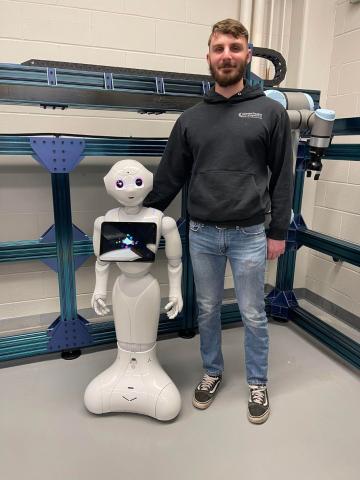
The equipment that will be purchased as part of AIDFab, will form part of a new shared laboratory for the Clarkson community. Some of the equipment being obtained for the project includes:
– A high-performance Xact Metal 3D Printer for metal powder-bed fusion in manufacturing, research and development
– Small-scale personal home robots: SoftBank Robotics’ Pepper, a semi-humanoid open platform robot capable of recognizing faces and basic human emotions, and Unitree’s AlienGo quadruped robot and Z1 robotic arm
– Actuators, sensors, circuit components, and microcontrollers will be acquired and a workspace for the development of robotic and electromechanical assistive devices will be established
“We anticipate that this project will have significant educational and societal impacts. Engineering students will learn to design devices that address real-world challenges through collaborations with individuals and occupational therapists. Further, the designs will be publicly disseminated and will help to solve challenges that people face today while aging in place. We are currently making connections with local agencies for aging and assistive living to help ensure that the developed technologies help meet the needs of our community,” Bazzocchi said.